
Redefining the Meaning of SEO in an AI world
AI-powered generative search is disrupting the organic search landscape. Is your institution’s SEO strategy still working? To reach today’s prospective students and boost enrollment, higher ed marketers must rethink how they leverage their websites, shifting from algorithmic optimization to an experience-driven strategy. Search Experience Optimization is a human-first approach that prioritizes users over the “engine” to build meaningful connections and enhance organic visibility in AI-driven search results.
Table of Contents
- Is SEO Dying?
- Search “Engine” Optimization vs. Search “Experience” Optimization
- Understanding the Impact of AI on Organic Search
- How Does AI Transform Student Search Behavior?
- 5 Tips to Optimize for Search Experience
- Repurpose Content to Expand Search Impact
Is SEO Dying?
You may have heard the phrases “SEO is dying” or “SEO is dead.” The sad news is that this may be true. If you optimize your website content only for search engine bots and neglect the human users’ experience, then SEO will not be a successful strategy.
SEO is more than traffic and rankings. Engagement and conversions have a greater impact, and prospective students are the source of those. Your content should prioritize people over bots.
It’s time to redefine the meaning of SEO and think of the “E” as representing “Experience” instead of “Engine”.
Search “Engine” Optimization vs. Search “Experience” Optimization
How does Search “Engine” Optimization differ from Search “Experience” Optimization? SEO once revolved around ranking tricks, such as stuffing keywords, duplicating pages, and optimizing for head terms. These outdated practices can hurt your site’s performance because they serve the algorithm first and don’t prioritize prospective students’ search experience.
With AI generative search growing in popularity, prospective students have high expectations of content quality. Websites that meet their needs, understand their concerns, and deliver helpful solutions will perform better in traffic, engagement, and conversions. To succeed, colleges and universities must optimize for the full search experience: user intent, usability, and value.
| Traditional Search “Engine” Optimization | Search “Experience” Optimization |
|---|---|
| Stuff keywords on web pages | Understand user intent and target question-based search terms |
| Prioritize content quantity over quality | Prioritize content quality over quantity |
| Create duplicate content | Create unique pages with clear purposes |
| Produce thin and low-value content | Produce comprehensive and in-depth content |
| Target only top-of-the-funnel keywords | Use a full-funnel strategy |
| Optimize text content only | Leverage multimedia |
Understanding the Impact of AI on Organic Search
Search experience optimization increases in importance daily as AI becomes more and more a part of students’ organic search behavior. For example, the introduction of Google’s AI Overview marked a major shift in how users interact with search results. Covering the first fold of the Search Engine Result Page (SERP), the AI Overview generates answers drawn from trusted websites with citation links on the side (see an example below).
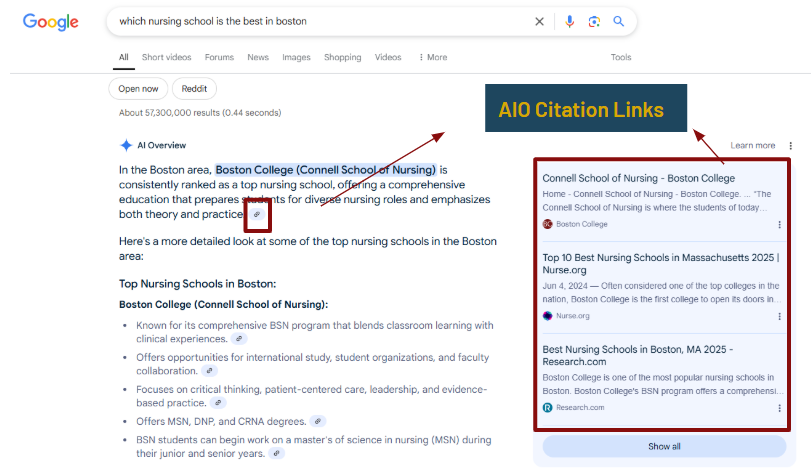
In addition to Google AI Overview, many other generative search engines have entered the market, such as ChatGPT, Claude, Copilot, and Perplexity. Google also just released a transformative search feature called AI Mode that empowers users to ask follow-up questions. Students and other higher education audiences now have more options to find the information they need. By leveraging machine learning and natural language processing, generative search engines provide a more advanced experience:
- Contextual comprehension: understand complex questions and requests.
- Personalized responses: can hold memories of search histories and past conversations to provide more relevant information.
- Synthesis from multiple sources: pull information from various platforms, including social media, databases, and websites.
- Chatbot-style search results: interactive conversations instead of simple links.
AI Is Transforming Student Search Behavior
With the new AI search experience, students’ search behavior is also evolving. Before AI-driven search, students typed in a keyword, scanned the top-listed results on the SERP, and clicked through websites one by one to find the information they needed. Now, they engage in conversations with search bots, asking longer and more complex questions and expecting instant answers.
Search is no longer like walking into a library and browsing a list of books. Today’s search experience is more like having a one-on-one conversation with someone who’s read all the books and can give you exactly what you need—instantly and with context. And better yet, AI recommends reliable sources to you if you want to get more in-depth information.
If you wonder how many students are using AI in their college search journey, the growth rate of website traffic from generative search engines might surprise you. While still a smaller share of total website traffic, the rapid increase signals a turning point.
According to our recent research, website traffic from AI tools and LLMs increased over 850% year-over-year.
– Elizabeth Glass, Director of Analytics, Carnegie
5 Tips to Optimize for the AI Search Experience
In the AI search era, optimizing for search experience requires us to craft content that meaningfully supports students’ college search journeys. Your content must go beyond answering what students are asking—it must demonstrate why your institution is most insightful to prospective students and other target audiences. Otherwise, they won’t want to click through your website, because AI answers can easily cover the basics.
Here is how you can do it.
1. Think Beyond Keywords
Keyword research is here to stay, but the approach to it has to change. With generative AI, students no longer only search with head terms such as “business degree.” Because of the conversational nature of AI search, students are increasingly utilizing long-tail queries to ask questions, find insights, and get advice. For example, they are more likely to search for “why getting a business degree is worth it” than “business degree.”
Accordingly, higher ed marketers need to shift from targeting keywords to targeting intent—in other words, understand what information students are hoping to receive by typing in that search query. This requires empathy and audience awareness. When optimizing web content, think, “What are students really trying to decide?”, “What doubts are they having?”, and “What help do they need?”
Learn more about keyword research.
2. Create Human-First Content
In the age of AI, the content that wins is content that connects with your target audiences and provides accurate information, compelling stories, and trusted solutions. If you follow Google’s EEAT quality content guidelines—Experience, Expertise, Authoritativeness, and Trustworthiness—you can ensure that generative search engines recognize your university’s website as a reputable source of information, which will increase your visibility in AI search results.
When it comes to creating meaningful content, I think many higher education institutions are not tapping into their most valuable resource—their people! Marketing teams should interview current students and faculty to craft more authentic web pages.
– Rebecca Hofstetter, VP, Content and SEO at Carnegie
Authenticity and personalization are key to being truly human-first. You should avoid creating fluffy, generic content. Instead, try to collaborate with subject matter experts like faculty and financial aid and admissions team members to produce authoritative content. Make sure it resonates with your intended audiences. Write as if you know them personally, offering a tailored experience and unique insights with a clear structure that can help them solve their problems and answer their questions.
Learn more about website personalization.
3. Invest in UX Design to Boost Your Search Experience
Your content is only as strong as the platform it lives on. Great content on a poorly designed website? Students would probably bounce before reading it, let alone request information or enroll at your institution. A page that loads in 3 seconds builds trust. One that loads in 5 seconds loses students to competitors.
To enhance user experience:
- Use fast, responsive designs with mobile-first layouts
- Structure content with proper header tags
- Incorporate intuitive navigation and calls to action
- Follow accessibility best practices
[In usability testing], prospective students shared that the website directly reflects the institution. A website with a stellar user experience will stand out in their minds compared to others with unintuitive designs. You may have a great on-campus experience, but most of them will visit the website as a first step. It’s your digital front door.
– Emerald Obie, Web Strategist, Carnegie
4. Target the Mid and Bottom of the Funnel with Thought Leadership Content
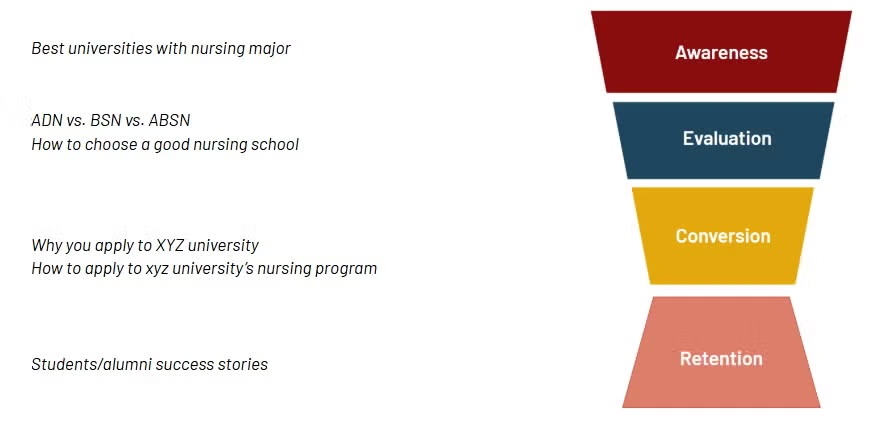
Building content that speaks to audiences in the awareness stage is not enough. Considering how AI search results can easily provide quick facts and answers to top-of-the-funnel awareness queries like “Best universities for nursing major”, higher ed websites have more opportunities to influence enrollment decisions through lower-funnel content.
For example, create content targeting a high-intent keyphrase such as “ADN vs. BSN vs. ABSN degree” to serve prospective students who are stuck in the middle of the funnel (evaluation stage), figuring out which program is right for them. As another example, a blog article featuring students’ and alumni’s perspectives on “why choose XYZ university” provides authentic and trusted advice to prospective students at the bottom of the enrollment funnel (conversion). In the retention stage, you could also create student and alumni success stories to validate the value of a particular program.
This type of decision-enabling thought leadership content not only fulfills students’ needs but also transforms clicks into enrollment.
5. Follow the SPAM Recipe When Optimizing Content
Since we’re redefining SEO, let’s redefine SPAM too. To consistently create high-impact content that can make you stand out in generative search results, follow this SPAM recipe:
Subject Matter Experts — Leverage faculty, alumni, and industry leaders to create content
Perspective — Avoid generic copy and offer original viewpoints
Audience Focus — Speak directly to student concerns and solve their problems
Multimedia — Use video, infographics, and visuals to increase engagement and shareability
When optimizing a web page, check if your content showcases unique perspectives from subject matter experts, solves your target audience’s problems, and incorporates various media formats. These are the necessary ingredients for high-performing web content in the age of generative search.
Repurpose Content to Expand Search Impact
Multimedia content marketing is the powerhouse of organic search performance.
Unlike traditional marketing, content marketing isn’t about overtly promoting your institution. It’s about building trust, establishing authority, and enhancing brand awareness over time.
– Ross Simmonds, Founder + CEO, Foundation Marketing
AI search engines not only extract information from the web but also from social media, YouTube, and many other places. So do your prospective students. They don’t just read blog articles—they watch videos, follow social content, and listen to podcasts.
Therefore, an efficient way to maximize your student reach is to repurpose your website content into different formats on various platforms. For example, you could write a blog post and turn it into a YouTube video or transform a student story into a social media post.
Implement a full-funnel content marketing strategy today with Carnegie!
SEO Strategy Reset: The Future of Organic Search Lies in the “Experience”
The rules of SEO are changing. It’s time to discard the outdated tactics that only serve the “engine” and focus on creating content that speaks to the prospective student “experience.”
Talk to Carnegie to learn more about organic search strategies and website design.