A Simple Yet Powerful Innovation to Higher Education Enrollment and Student Communication
As higher education reflects on a year of uncertainty and toward an oft-cited demographics cliff, the importance of smart enrollment strategies and precise communication to students climbs ever higher. Carnegie believes expansive research on student personality has uncovered a major opportunity for any school looking to increase yield and inspire the next wave of college-bound audiences.
Why is personality so important?
In a nationally representative student survey, we set out to prove that personality makes a difference when audiences consume different types of written and visual content. The theory was simple: Students remember and connect with communication that reflects their own inner personality. Our results (currently being prepared for academic peer review) showed a person’s score on an archetype is a positive and significant predictor of how well they rate both written content and visual images that reflect that archetype.
The reality, though, is that personality is very complex. In Carnegie’s research on the nine archetypes of human personality, the levels and intersections of personality reach literally millions of combinations. This would be impossible to segment or use in a strategic manner. Luckily, by using our national data we had the ability to consolidate this complexity into a general, accessible model. By using this motivation model, we can find a root to personality that is usable for message segmentation, enrollment strategy, retention, and more through a single, elegant variable in your CRM. We call this variable the Carnegie Motivator.
What groups make up the Carnegie Motivator?
The three motivators are Strength, Vitality, and Creativity. While anyone could draw inspiration from each, humans gravitate toward a Primary Motivator. This baseline sets up the foundation of decisions and behaviors. Instead of asking students purely about what they do, this importantly keys in on why they do it.
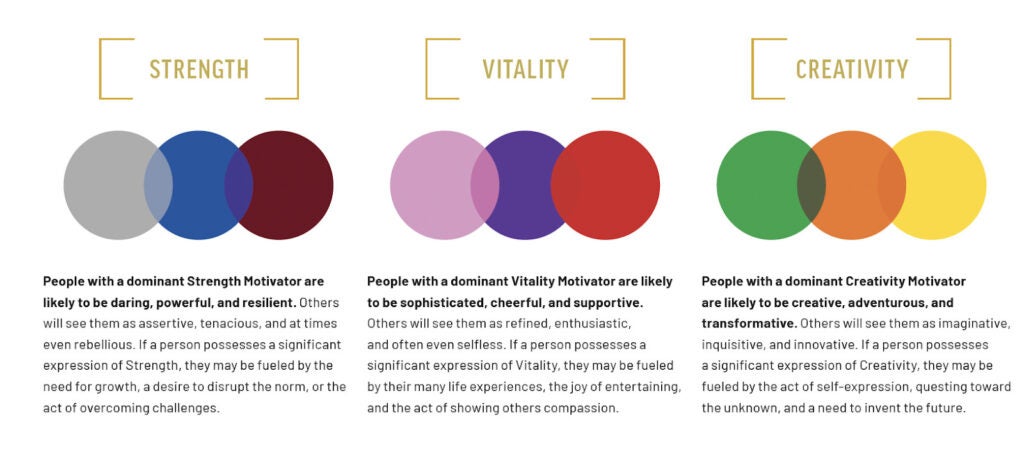
As an example, two students might stay up all night to complete an assignment. A person primarily driven by the Strength Motivator may have done it to prove themselves and overcome the challenge of the assignment. A Vitality-driven student stayed up all night because they have a good friend also doing the assignment and co-working makes them feel better prepared. A student with the Creativity Motivator stayed up because their curiosity took them on a journey through the topic they couldn’t break away from. Staying up all night to finish something is a behavior, but the more important information we get from the situation is why the person stayed up. That drive, the pure personality variable, is the solution to creating authentic communication and understanding student behavior.
How do you identify a student’s Carnegie Motivator?
While the optimal way to identify a motivator is a fully realized survey, the reality is that the majority of inquiries and applicants won’t be accessible survey participants, and the process of surveying all your prospects is lengthy and costly. Luckily, human motivations are tied to a series of demographic, psychographic, and lifestyle variables to which Carnegie has access to based on a student’s home address. As such, we can tag most students in the United States for their Carnegie Motivator after being supplied with just an address and an ID to tie back to your CRM.
What do I do with the Carnegie Motivator in my CRM?
Sometimes good research gets a bad reputation for not being actionable. The Carnegie Motivator bucks that trend because it was designed to be one of the most unique and versatile variables in your CRM. A savvy user can start by using the Carnegie Motivator to look at historical trends in student yield. For example, are you great at attracting the Strength Motivator but can’t get Vitality students to enroll? This variable can help strengthen an enrollment or financial aid modeling effort to produce the most yield from prospects.
I worked in University communications while I was a graduate student. One of the hardest parts of producing content was fixing a voice to the messages and matching that voice to an audience. The Carnegie Motivator is designed to do just that. Any comm-flow to students can be segmented by the optimal personality lens. While the nuts-and-bolts message of a student touchpoint could be the same (for example, an email about your early admission process), key images, words, and topics can be tailored to each motivational segment.
The motivational system can further support a myriad of other branding, marketing, and communication efforts that support enrollment. For example, website landing pages can be customized to different motivators. Retention modeling or student advising can use the motivators to give current students the most inspiring experience. Graduating students can be sent alumni relations materials focused on not just their major but also their personality.
For those wanting more information or training on implementation, we’re ready to bring your team up to speed on the most innovative ways to use the Carnegie Motivator.
How does the Carnegie Motivator differ from student personas?
Remember the millions of personality combinations mentioned earlier? A Carnegie Motivator is a generic breakdown of the three most common zones of personality. A student persona, if developed properly, is more specific to combinations that are most prevalent at your institution. As such, they require a lot more foundational information and research engagement. The Carnegie Motivator is immediately ready to be plugged into your CRM and is applicable to any institution.
Of course, Carnegie sees student personas as a natural extension when a school has the research time and resources ready for a custom and in-depth engagement. We call this Darts, a groundbreaking personas product that ultimately leads to a similar address-based tagging system while having a custom strategy and creative approach. They both run on the same principle, with the Carnegie Motivator being a general strategy for anyone to employ right away and Darts being the most powerful segmentation process in higher education with the right research engagement.
Regardless of your approach to enrollment and student communication, consider the immense opportunity of knowing the why behind student behaviors.
Get started with the Carnegie Motivator
To learn more about Carnegie’s audience segmentation services and to get started with your personalized enrollment and marketing efforts, contact us today!